
Due Process of Law
My book Ghostly Gambits is a fun, lighthearted story about a life-size chess match played by ghosts. Its inspiration? Not so much.
Let’s open with the fun stuff: the premise of Ghostly Gambits. Later, I’ll share the dark true story behind the real-life Chess Park, and you’ll probably see why it didn’t find a home in my magical cozy mystery.
Ghostly Gambits
When the ghosts of two town founders resurrect a historic rivalry, they agree to face off on a life-size chessboard. The showdown pits Henry Addison, a visionary industrialist, against Hettie Stillson, a staunch Temperance advocate. And for this ghostly game, they’ll play with spectral armies of ghosts, paranormal players standing in for all the pieces.
Their coveted trophy: a bottle of wine so rare, it glows with the spirits of vineyards long since past, guarded by a priest whose love for a fine vintage is surpassed only by his reverence for the sacred rules of play.
Marley Montgomery is the proprietor of the Enchanted Antique Shop. Her friend Sadie is a history professor. And when Violet, one of the shop’s resident spirits, invites them to witness the metaphysical match, it’s an offer they can’t refuse—especially since Violet, a spirited 1920s flapper, will play the part of the white queen.
Amidst a symphony of otherworldly melodies, Marley and Sadie discover that in Enchanted Springs, the game of chess is a dance of destiny, where every move echoes through eternity, and the shadows of history come alive to play their part.
The Hanged Man of Chess Park
In the game of chess, the rules are black and white. Pawns hope for promotion, knights fight for victory, and rooks stand stalwart against intrusion. Armies march across a field of precision angles, opponents clash in silent battles, and wars are fought without a drop of blood. It’s an idealized battleground, and in DeLand, there’s an entire plaza dedicated to the game: Chess Park.
Ironically, Chess Park is strategically positioned next to the old courthouse—where legal conflicts weren’t always so defined.
Chess Park is an oasis of landscaped outdoor rooms, with concrete chess tables, a life-size chess board, and chess-shaped sculptures on pillars and walls. It’s open from sunrise to sunset—but when the sun slides below the western horizon, new players come into the match. As the moon rises, DeLand’s ghosts and spirits step out of the courthouse shadows, still pondering their final move.
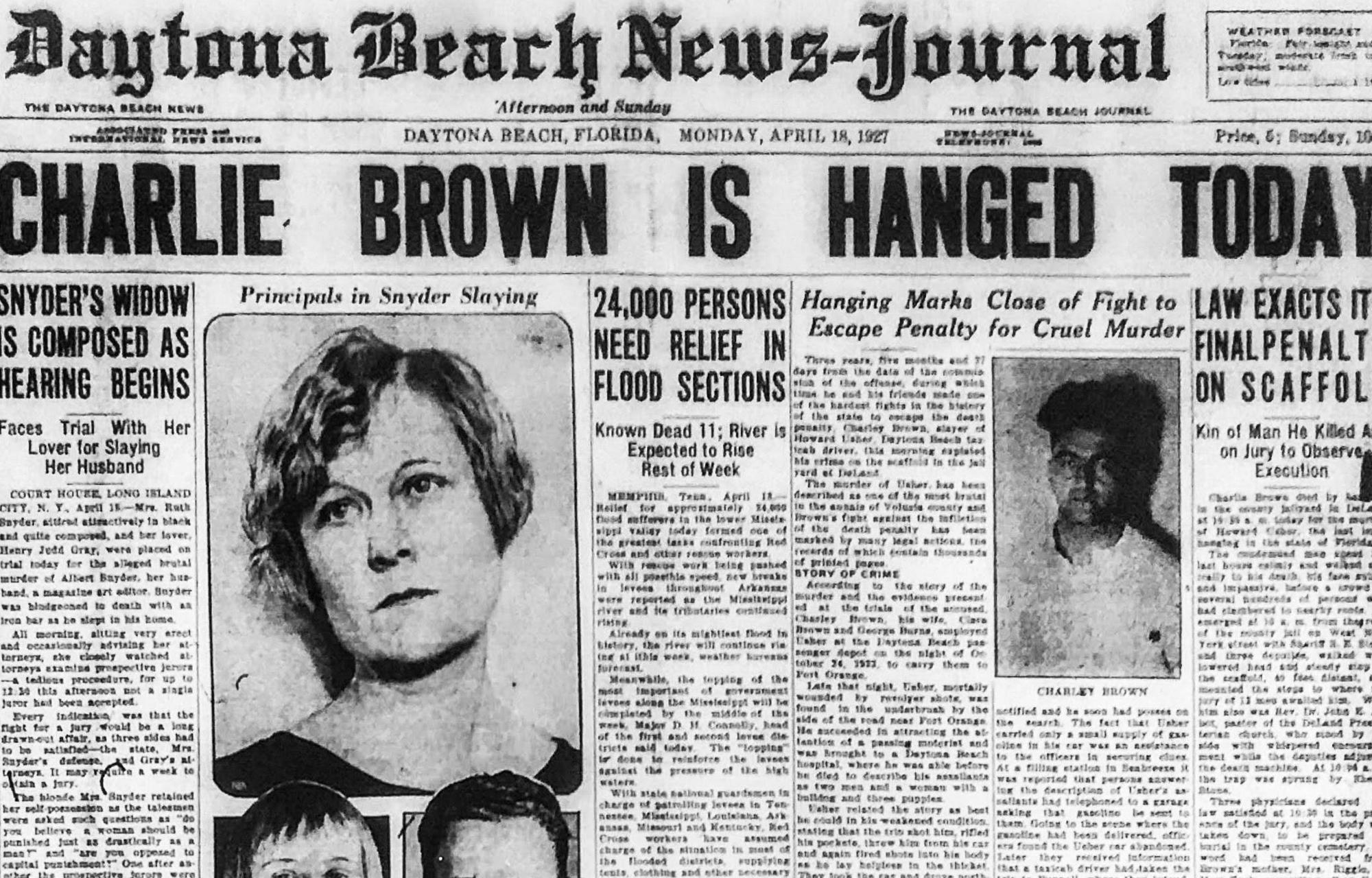
Stand quietly, and you’ll see the ghost of Charles Browne Perelli sitting at a table by the wall, his neck still caught in a hangman’s noose. Look carefully, and you’ll also see his attorney, Rose Falls Bres, who fought to save his life.
“Charlie Brown,” as the locals called him, was tried here, sentenced here, and executed in a jail yard across the street. His earthly life came to an end on April 28, 1927. As the last man hanged in Florida, his case lives on in legend.
Brown, 29, was convicted of murdering a cab driver named Howard “Red” Usher. Brown didn’t act alone: he’d been accompanied by his wife Clara and an accomplice named George Burns. The three of them had hired Usher to drive them from the Daytona Beach train station to Port Orange. Once they were in the cab, they robbed him, shot him three times, and left him for dead by the side of the road. Usher managed to flag down a passing motorist, and he lived long enough to describe his killers. Police found the trio waiting for a train in Bunnell.
Brown’s wife testified against him, and she was acquitted. Accomplice George Burns was sentenced to life in prison. “The damn stool pigeon squealed,” Brown said later. Brown, considered to be the ringleader, was sentenced to death.
His first conviction was overturned on appeal, but then he was convicted again. He was headed for the electric chair when, at the last minute, the governor halted his execution. That’s when attorney Rose Fall Bres made a final desperate appeal to the state supreme court—a last-ditch effort to save his life by insisting upon the letter of the law. Electrocution was the new law of the land, but she argued that Brown had been sentenced to death by hanging, and that was the penalty he should receive.
Bres didn’t get the dismissal she wanted. Prosecutors were ready with a checkmate. Within days, a circuit judge resentenced Brown to hang, the governor signed a new death warrant, and the sheriff brought Charlie Brown back to the Volusia County Jail, where a pinewood scaffold had been hastily constructed.
On the morning of the hanging, crowds gathered bright and early. More than 2,000 spectators came to watch. Not only did they revile Charlie Brown, but they knew it was the last public execution they would ever see. It was practically a holiday. Shops and offices closed, and citrus farmers came in from their orange groves. Schools were dismissed so children could attend. Onlookers crowded the street, and some stood on rooftops to get a better view.
The sheriff met Brown in his cell and tied his hands behind his back. Then he and three deputies led the convict up the thirteen steps to the gallows, put a black hood over his head, and slipped a noose around his neck. A Presbyterian minister prayed.
The sheriff asked, “Charlie Brown, are you ready?”
Brown didn’t answer. Earlier, he had already uttered his last words. “Great sins have been forgiven,” he said.
The trap door sprang open at 10:06 a.m. and Brown plummeted through the gaping void. The rope jerked, then began to swing back and forth, hitting the opening on either side, over and over again. Brown’s neck was broken, but he still had a pulse, and his body twitched reflexively. For twenty-four minutes, Brown swayed at the end of the rope, while the crowd watched in horrified silence. At 10:30, a doctor finally pronounced him dead.
The children who watched the execution were traumatized. Decades later, one of them said that afterward, he wouldn’t even pick up a pencil off the street, for fear that he’d be accused of theft and hanged.
Rose Falls Bres was both traumatized and disgusted. She later described the execution in her ongoing attempts to eradicate the death penalty.
“It was a barbaric picnic party,” she wrote. “In this execution there was the real hundred percent thrill of witnessing the twitching for nearly thirty minutes of a young man, hung by the neck by ‘due process of law.’”
Brown was buried in a pauper’s grave near the county poor farm, about a mile from downtown DeLand.