
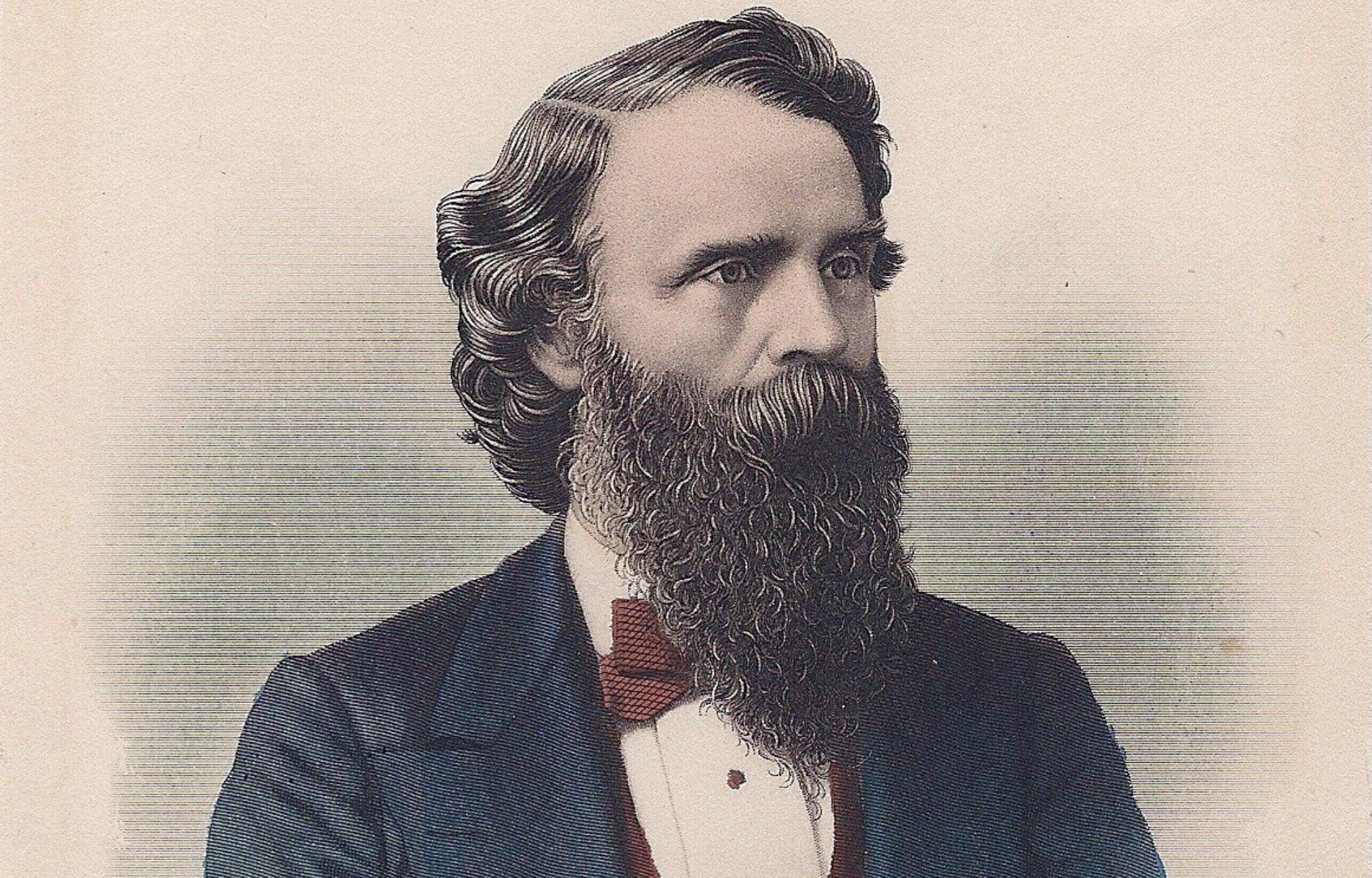
Henry Addison DeLand
He lost everything—but failed at nothing.
I wouldn’t be living in DeLand—or writing about a fictionalized version of my adopted hometown—if it weren’t for Henry DeLand. He dreamed of founding the “Athens of Florida,” a community dedicated to art, culture, and education.
Ultimately, he succeeded—but it destroyed him, and came at the cost of his entire fortune.
When Henry DeLand first came to Florida, he was one of the country’s wealthiest men. He sold baking powder and baking soda, which sounds ordinary to us now. But in his time, his products were revolutionary. We’ll get to that in a bit.
In the spring of 1876, the native New Yorker visited the area for the first time. He came with his brother-in-law, Oliver P. Terry, an aspiring investor with “orange fever” who wanted to buy land for citrus groves. Henry hated every mile they traveled across Central Florida, until they came to an area known as Persimmon Hollow—the future site of the town that would bear Henry’s name.
On his first night here, he stayed with John and Clara Rich. Henry was a millionaire, but that night he slept on the rough pine floor of their log cabin. He had a primitive mattress—a bedroll, really—stitched together from Civil War Army blankets stuffed with pine needles, then covered with quilts. It was a far cry from the featherbed he was used to in New York. As he twisted and turned, looking for a sweet spot that would let him drift off to sleep, Henry happened to glance up at the wall. There, through chinks in the stacked logs, he could see stars dancing in an indigo sky.
He was enchanted. As he continued to gaze out at the night sky, his mind was imagining a future almost too wonderful to believe. Already he was picturing the town he would build here.
The next morning, Henry bought a hundred and sixty acres next to the Rich homestead. He also made plans to come back and buy more land. In fact, he would buy every available parcel in the area.
He returned in the fall, made his land deals, and called all the settlers to a public meeting. As they gathered, once again in John Rich’s log cabin, Henry described his vision for a new town.
The settlers loved what they heard—especially when Henry offered to donate land for a school and pay half the cost of the building. He also donated land for a church and a mile-long stretch of land for the town’s main street, Woodland Boulevard. He built a hotel and founded the DeLand Academy, which would later become Stetson University.
Back in New York state, he had made a fortune selling baking soda and its derivative, baking powder. Today, we take baking powder for granted, but when it was first introduced, it revolutionized the world of home cooking. Without baking soda and baking powder, bread dough was an art most women didn’t have time for, and cakes invariably fell flat. When baking soda was introduced, home cooks could successfully whip up their own baked goods in minutes, rather than hours or days.
Henry set to work marketing his new hometown just as enthusiastically as he had promoted baking powder. He advertised his DeLand properties in almost a hundred different newspapers and magazines all over the Northeast and Midwest.
He also guaranteed buyers that if they were unhappy within the first two years, he would buy the land back. That promise would cost him his entire fortune.
Central Florida is sub-tropical, not tropical. Summers are hot and sunny, and winters are generally mild. That doesn’t mean winters are always warm. In December and January, short cold spells snap everyone to attention, with chilly winds at night and frost in the morning.
In the early morning hours of December 29, 1894, the temperature dropped to eighteen degrees. On February 19, it dropped to nineteen degrees. The cold obliterated acres and acres of young citrus trees. Grove after grove was destroyed. The sap in the fruit trees froze, splitting them open and killing them to the roots. The fruit, shriveled and black, fell to the ground, while dead leaves dangled from lifeless branches.
Before the Great Freeze, Florida had produced six million boxes of fruit per year. After the catastrophe, production plummeted to a hundred thousand boxes. Land lost ninety-nine percent of its value, dropping from a thousand dollars to ten dollars per acre. In other words, Henry DeLand’s investment was worthless.
Homesteaders abandoned the area in droves. According to legend, some were so distraught and in such a hurry to leave that they left dirty dishes on their dinner tables.
Heartbroken, Henry DeLand gave up his entire fortune to make good on his promise. He went back to New York and resumed his career in the baking soda industry. He sold his property in Florida, as well as his New York mansion, and the family moved into a modest, middle-class home. He worked until he had paid off all his obligations.
As Henry struggled to rebuild, he faced even greater tragedy. His wife Sarah was declared legally insane, a situation no one wanted to talk about. In 1903, their son Harlan died of tuberculosis, leaving a wife and three young children. He was only thirty-six.
Henry returned to DeLand for a final visit in 1908. By then, the town had rebounded, and he was welcomed like a long-lost friend. At a gathering of the Old Settlers’ Society, he described the town’s origins so emotionally there were tears in his eyes. He also said that seeing his old friends was like “a foretaste of heaven.” Those words proved to be eerily prophetic. On the way back to New York, his health suddenly failed. Within days he was unconscious, and less than a month later, he was dead.
Later, his nephew Frederick would write that Henry DeLand’s life had been a paradox. “He lost everything,” he wrote, “but failed at nothing.”
Even now, more than a century after his death, Henry DeLand is still a familiar face in the city he founded. The headquarters of the local history center is named in his honor. His photo hangs in shops and restaurants. Most notably, there’s a larger-than-life mural of Henry DeLand at a downtown intersection, where he keeps a watchful eye over the city’s people as they walk and drive along the main street he laid out in 1876.