
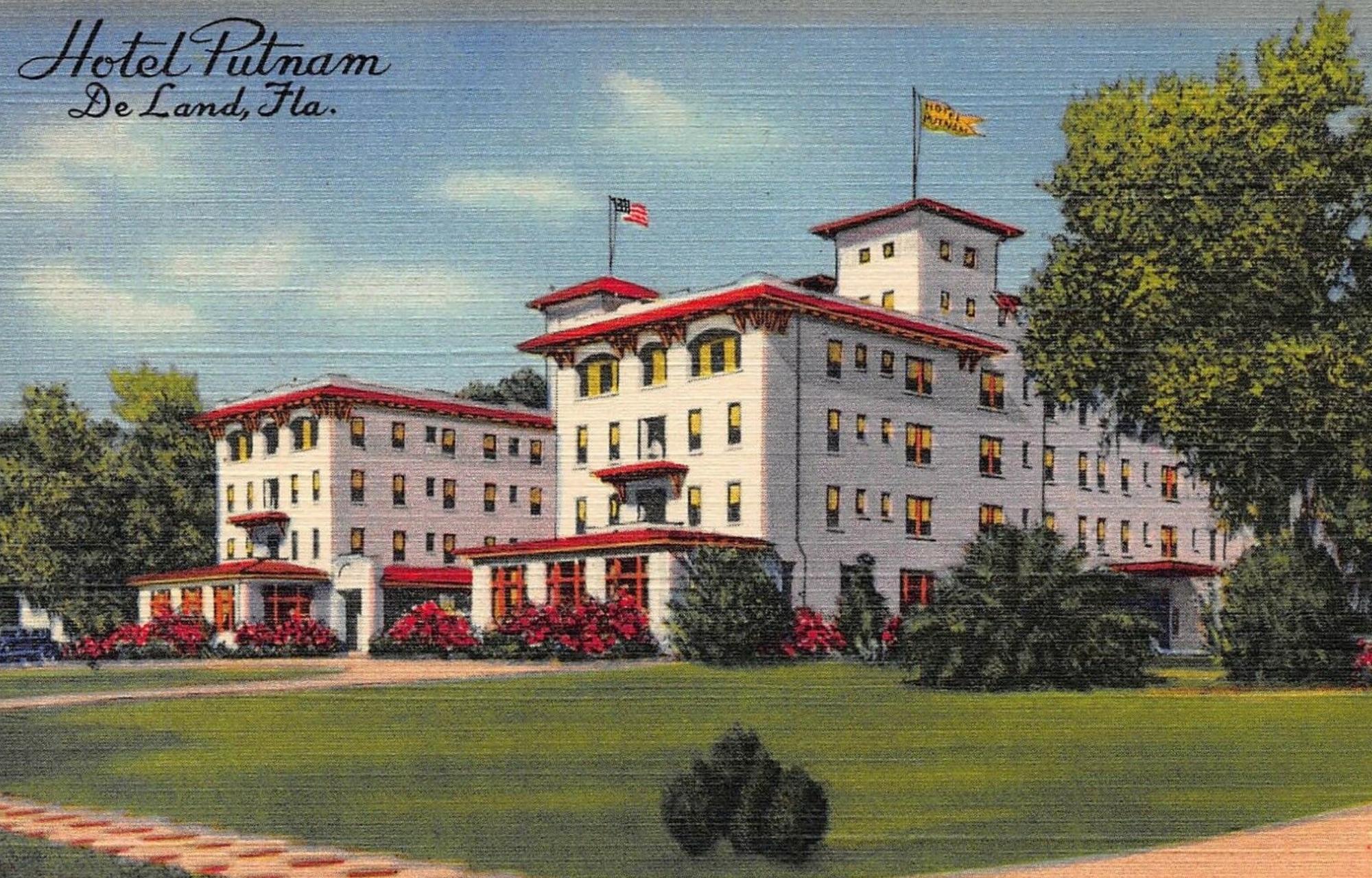
Hotel Putnam
The Hotel Putnam was the inspiration for Enchanted Evening.
Long before it became a ruin, the Putnam was a landmark of elegance in downtown DeLand, a destination for the upper class who wintered in Florida. In its prime, it was the sort of place that promised style, status, and a little theater. Guests arrived expecting beauty. They found grand rooms, polished surfaces, and the kind of atmosphere that made people feel they had stepped into a more glamorous world.
I never saw it in those glory days.
By the time I came to DeLand, the hotel had become a crumbling wreck, a ghost of its former self. Its grandeur had faded into neglect. Its halls had gone dark. Its beauty had not vanished so much as curdled into something eerie and sad. Even in decline, though, the building still had presence. It still carried the bones of its old life. You could look at it and see what it had been. You could also look at it and feel what it had become.
That contrast caught hold of my imagination.
As I stood there looking at the old Putnam, I began to wonder what a place like that might mean in a town like Enchanted Springs, where the paranormal population lives in plain sight by hiding what it is. Not with invisibility. Not with a sparkle or a dramatic flourish. With misdirection. With camouflage. With a reverse glamour.
In folklore and fantasy, a glamour usually makes something appear more beautiful than it is. It flatters. It enchants. It conceals the truth behind a lovely illusion. But what if magic worked the other way? What if the best way to protect a secret meeting place was to make it look worse, not better? What if a hidden world chose to disguise itself beneath rot, dust, peeling plaster, and failure?
That idea fascinated me.
A reverse glamour would be the perfect disguise for a paranormal gathering place. Most people run from decay. They do not investigate it. They write it off. They avert their eyes. They assume nothing of value remains inside. A crumbling hotel would make an ideal cover for a place that still hummed with secret life after dark. The living would see a wreck. The magical community would see a sanctuary. One world would notice only rubble and shadows. The other would step through the same doors and enter a glittering realm of music, secrets, danger, and old power.
That was the spark behind Enchanted Evening.
The novel grew from that image: a once-majestic hotel whose faded exterior hides a world still very much alive. A place that the ordinary eye dismisses, but the right eye understands at once. A place where elegance never died. It only learned how to hide.
That is part of what made the Hotel Putnam so powerful as inspiration. It did not feel like an empty shell. It felt bewitched by history. It felt layered. It felt like a building that had seen too much, kept too much, and refused to give up all its secrets at once. It invited questions. Who had danced there? Who had plotted there? Who had loved there? Who had died there? And what if some of them never really left?
Shortly after I finished writing the book, the once-majestic hotel succumbed to the wrecking ball.
That loss still stings.
It is one thing to lose a building that has outlived its purpose. It is another to lose a place so rich in atmosphere, memory, and story. The Putnam had already fallen far from its original splendor, but even in ruin it still possessed a strange magic. It stood as a reminder that places can survive in altered form, carrying both their past glory and their later sorrow in the same skin.
The real hotel is gone now. But in another sense, it is not gone at all.
It survives in memory. It survives in imagination. And for me, it survives in Enchanted Evening, transformed into fiction but still rooted in that first powerful impression: a fallen palace in the middle of town, hiding its secrets under dust and decay, waiting for someone to imagine what still lived inside.