
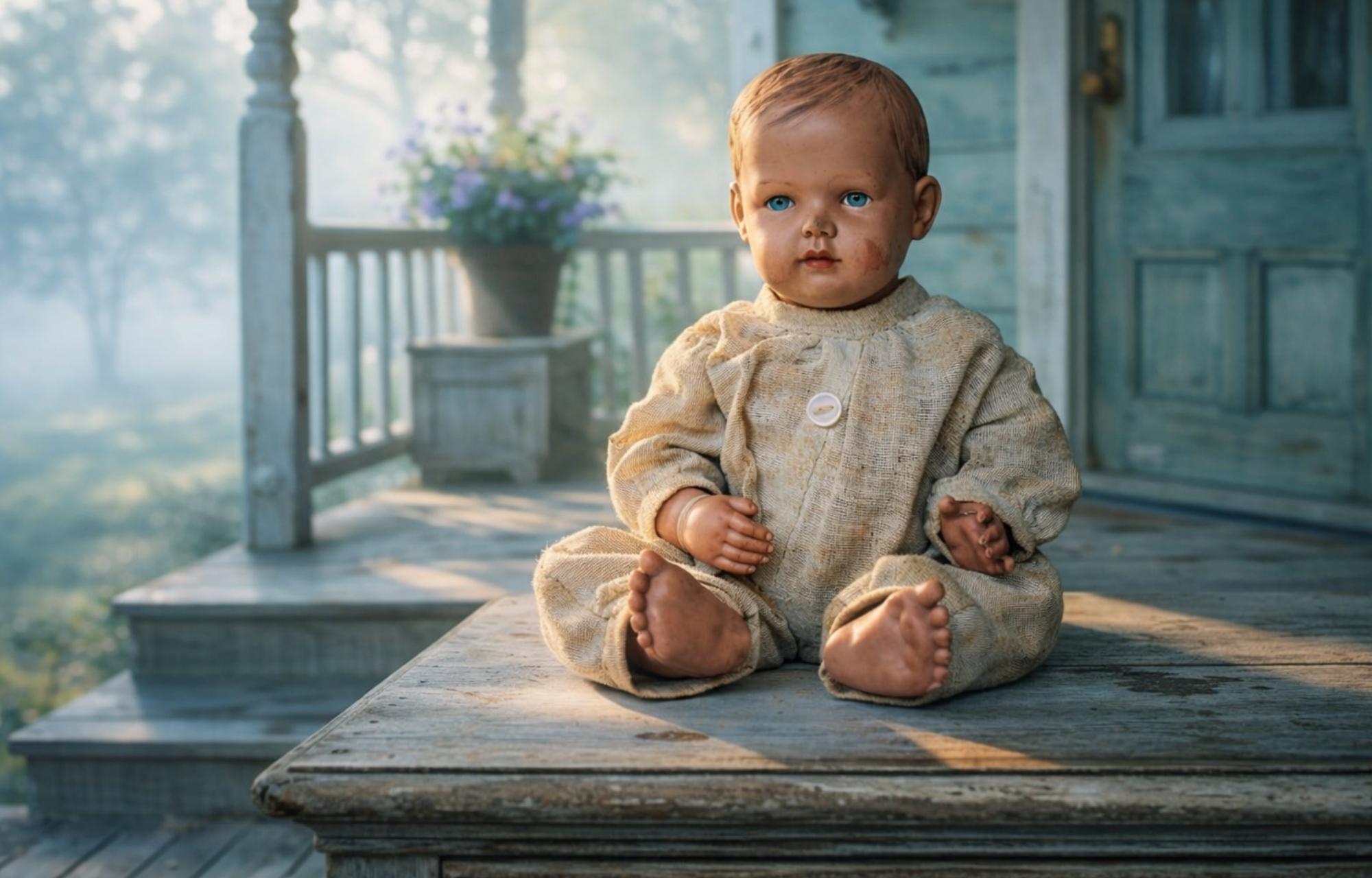
For five years, I owned a gently haunted antique shop. That’s where I started writing the Enchanted Antique Shop series.
I was surrounded every day by old furniture, vintage collectibles, faded photographs, and the quiet, lingering atmosphere that antique shops seem to gather naturally. And yes, like almost every antique store you’ll ever visit, my shop was gently haunted.
One of the most memorable residents was a doll named Charlie.
Charlie was a composition doll, probably close to a hundred years old, made from old-fashioned materials like sawdust, glue, and resin. He had a serious little face, bare feet, a yellowed linen romper, and a slightly dented nose that somehow only made him more endearing. There was also an old bit of string tied around his wrist, the sort of small leftover detail that makes you wonder about the child who once loved him.
He wasn’t the prettiest doll in the shop, and he certainly wasn’t the most valuable. But he had presence.
If you’ve ever spent time around antique dolls, you probably know what I mean. Some people adore them. Others would rather back quietly out of the room than make eye contact. There’s something about old dolls that stirs a strong reaction. Maybe it’s the uncanny stillness. Maybe it’s the sense that they’ve outlasted everyone who first held them. Maybe it’s simply that they feel less like toys and more like little witnesses to another time.
Charlie was that kind of doll.
I found him at a swap meet, sitting among a jumble of worn old toys, and brought him back to the shop. Not long afterward, we began noticing that his arms moved. Not in the ordinary way old doll limbs shift and sag, but in a way that felt oddly deliberate. I’d position his hands neatly in his lap or rest his arms comfortably on his little chair, only to come back later and find them lifted higher or spread wider. He didn’t seem to droop with gravity. He seemed to rearrange himself.
Over time, Charlie became a regular fixture in the shop.
Sometimes he sat on the mantel. Sometimes he watched over the register. At one point, I placed him inside our Cabinet of Curiosities, where he seemed perfectly at home — at least for a while.
Then one Saturday, three visitors came in and asked the question every owner of an unusual antique shop eventually hears: why do you call this place haunted?
We showed them Charlie and explained, as casually as one can, that his arms sometimes moved in ways that were hard to explain. They listened politely. One of them, a man named Tom, sat down in a nearby rocking chair while the others studied the cabinet. Then came a sudden clunk from inside. Everyone heard it. Tom immediately said, “Charlie just turned around.” The cabinet doors were closed. No one had touched him. But when we opened the doors, Charlie was indeed facing backward, his chair twisted around on the shelf as if someone had taken hold of it and turned it by hand.
That was enough for Tom. He was out the door in seconds.
I, on the other hand, was fascinated. Charlie never felt malicious to me. He felt opinionated. There’s a difference.
Later, a few sensitive visitors said they had the distinct impression that he disliked being shut away behind closed doors. So I moved him out of the cabinet and gave him a more open place in the shop. That seemed only fair.
Not every haunted object belongs in a horror movie. Some feel eerie. Some feel sad. And some feel strangely companionable, as if they’ve simply stayed a little too long in this world and would like to be acknowledged.
Charlie was like that.
He didn’t make me afraid to open the shop in the morning, but he did make me wonder what old objects remember, and whether certain things can hold more than age and dust. That sense of mystery stayed with me long after the shop was gone, and it absolutely found its way into my fiction.
Because if you ask me, that’s where the best paranormal stories begin—not with something monstrous, but with something ordinary made just a little mysterious.
Sometimes it’s an old doll with a dented nose.